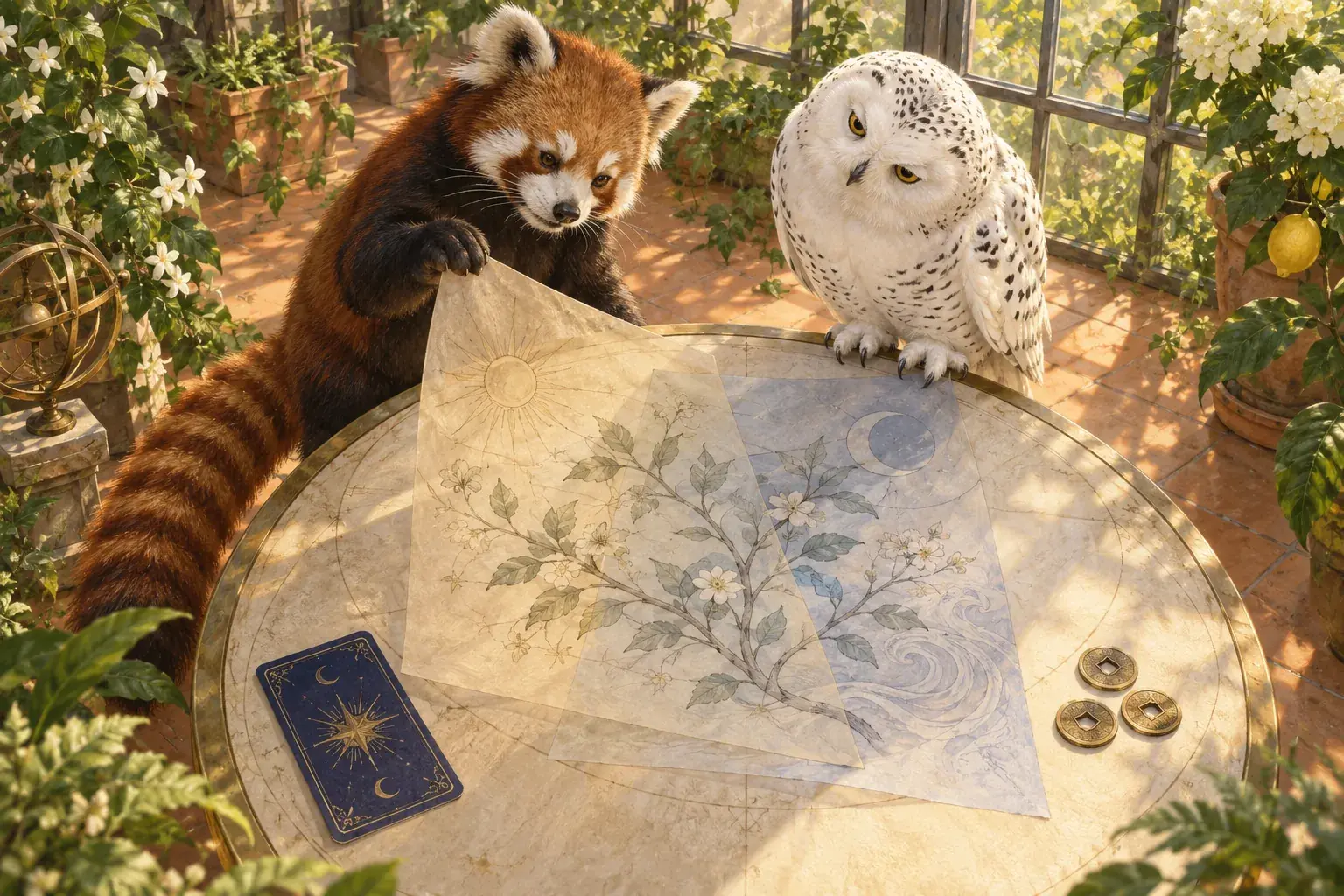
Carl Gustav Jung gave serious attention to parts of human experience that can be difficult to put into words. A dream, an unexpected association or a picture that holds our attention could become a subject worth examining. His work invited a larger conversation about what it means to understand a person.
At DuoSages, we appreciate that willingness to ask. This tribute honours Jung's contribution to self-understanding, especially his engagement with the I Ching and his remarks about Tarot. It also follows the question those interests raise today: how can a symbolic reading contribute to a more thoughtful life?

A life devoted to the inner world
Jung was a Swiss psychiatrist and the founder of analytical psychology. Born in 1875, he worked at Zurich's Burghölzli hospital and later taught at ETH Zurich. He died in 1961. The ETH Library now holds an extensive archive of his manuscripts and correspondence, a reminder of the sustained work behind the familiar name. ETH Library's biographical record provides those details.
The part of his work we celebrate here is his attention to human complexity. A person can have a clear account of who they are and still encounter reactions that surprise them. That gap creates room for inquiry. What has been overlooked? What might a different account reveal?
Growth as a fuller understanding of the person
Jung used the term individuation for a psychological process of becoming a whole individual. In his essay on its meaning, he argued that the conscious ego does not represent the entire person. Unconscious processes also belong to the personality, and their effects may appear in behaviour before they are recognised consciously. This is his theoretical account, described in The Meaning of Individuation.
For everyday reflection, that distinction offers a useful question: how well does an established self-description fit what actually happens? Someone known for being dependable might discover that agreeing to every request has left important commitments unfinished. The next step could be to make a clearer agreement about what is possible.
That example is our own. It brings the discussion back to conduct. An interpretation becomes more useful when it helps a person examine a recurring pattern and consider a response that can be put into practice.
What the I Ching offered Jung
Jung wrote the foreword to the Wilhelm/Baynes edition of the I Ching first published in English in 1950. There he described his own consultations and placed particular emphasis on examining character and motives. One short sentence states his interest directly: ‘The I Ching insists upon self-knowledge throughout.’
His interest came with questions. He considered possible errors in the text, translation and interpretation. He also stressed that the original question sets a limit on how an answer should be understood. The foreword holds curiosity and critical scrutiny together.
That is a valuable habit to carry into a consultation: keep the actual question visible, read the passage carefully and explain how an interpretation connects to the situation.
Synchronicity and the significance of an encounter
In the same foreword, Jung used synchronicity to discuss a connection through significance between a person's situation and a coinciding event, rather than an ordinary causal explanation. This was his proposed way of understanding the encounter with the oracle. It does not establish that a reading can predict an outcome.
A symbol's personal significance and evidence about an event remain different questions. Both deserve attention when a reading is discussed.
Tarot as a language of images
Jung's documented Tarot remarks are more limited than his engagement with the I Ching. In the seminar of 1 March 1933, recorded in Visions, he discussed Tarot pictures as psychological images and connected their symbolic situations with unconscious processes. He also drew an analogy with the I Ching's reading of present conditions. See the reproduced seminar passage.
He speculated about possible prediction in that discussion. The remark supplies no demonstration that prediction works. Nor does the passage establish a complete Jungian Tarot method. Later readers developed further interpretations using his ideas.
A pictured scene can nevertheless provide a concrete starting point for conversation. What draws attention first? What has been left at the edge? What alternative reading of the image is possible? These are our suggested questions for looking closely. They should be connected to a named card source and the actual situation.

From a reading to a conversation in everyday life
Consider a hypothetical community garden project. A volunteer coordinator asks how to prepare for a change in responsibilities. In a combined reading, the Tarot interpretation raises a question about accepting support. The I Ching interpretation raises a question about preparation and timing. The two interpretations address different parts of the coordinator's question.
The coordinator writes down the proposed connection, then checks it against the project. A planting session has moved to a new date. Several volunteers have offered help, but nobody has agreed who will bring the equipment. Those are facts that can be established through an ordinary conversation.
The resulting action is specific: contact the volunteers, confirm the revised date and agree how to divide the work. Looking back afterwards may show that the coordinator had assumed responsibility for tasks others were ready to share. It may also show that a proposed interpretation fitted poorly. Both findings belong in the record.
This exercise is original DuoSages work, inspired by the broader invitation to examine assumptions. Reflection earns its place through the quality of the questions it opens and the care taken with the answers.
Continuing the conversation at DuoSages
Every DuoSages reading brings Tarot and the I Ching together around one question. Their perspectives become part of one interpretation, which can then be explored through follow-up conversation. The two traditions retain their distinct sources and histories.
Jung's work helps inform our interest in that conversation. We value the attention he gave to symbolic life and the questions he raised about knowing oneself. The combined DuoSages format is our own approach.
To honour his work is to keep asking carefully. A fuller understanding of ourselves can include revising a familiar account, admitting what remains uncertain and responding more considerately to other people. There is room for curiosity and humour in that work, as well as patience. The conversation stays open.
Sources
Jung's I Ching foreword, especially its account of synchronicity and passages on self-knowledge and interpretation; The Meaning of Individuation, opening paragraphs; Visions: Notes of the Seminar Given in 1930–1934, seminar of 1 March 1933, Vol. II, pp. 923–924, reproduced passage; ETH Library's Jung record. The garden example and reflection questions are original DuoSages work.