Yes. A skeptical reader can use Tarot imagery or an I Ching passage as a prompt for examining a question. That approach does not require treating a consultation as evidence that it predicts events. It is one way of engaging with traditions that also have spiritual and divinatory uses.

State what the session is for
A reflective session might aim to generate a question, compare possible interpretations or notice an assumption. Define that purpose before drawing or casting. It gives the session a result that can be described without claiming supernatural proof.
A person using a spiritual approach may understand the same consultation differently. Respecting that difference does not require making identical claims. The practical example below focuses on using a reading to examine a question.
Separate an interesting connection from an established fact
Suppose a hypothetical reader considering an exhibition draws a card and connects it with preparation. The connection may prompt a useful question about installation help. It does not establish that help is available.
The venue's reply can answer that question. Keeping the symbolic suggestion and factual answer in separate notes makes the distinction visible. An interpretation can be useful as a prompt even when it does not supply knowledge of an event.
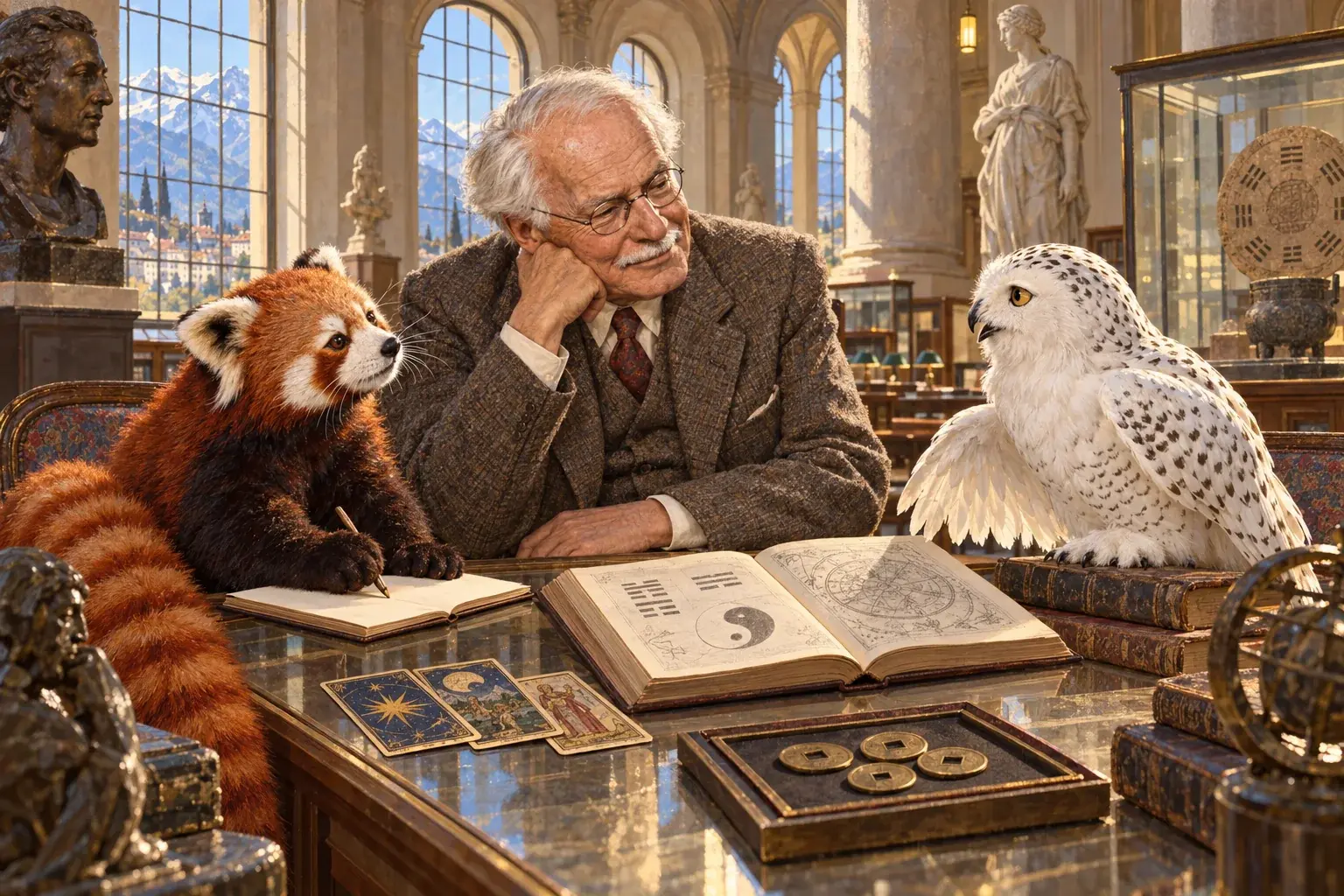
Read Jung as a historical participant
In his I Ching foreword, Jung describes his own consultation and acknowledges questions about the text, translation and interpretation. His account shows how he approached the practice. It does not provide experimental validation of predictive accuracy.
A skeptical reader can examine that account without adopting all of Jung's conclusions. The useful task is to identify what he reports, what he interprets and where his argument depends on his own judgment.
His interest should not be used as a shortcut around the question of evidence. A respected person's engagement is a reason to read the passage carefully, rather than a reason to accept every claim attached to the practice.
Allow a reading to miss
For the exhibition example, an interpretation about working in isolation may not fit a project already developed by a group. Record the mismatch. There is no need to invent a concealed conflict to preserve the explanation.
An alternative can be tried if it has a clear connection to the picture or passage and the known situation. Keep the alternatives visible so that later review does not erase the ones that failed.
Choose one question and one consultation. Write the source, one proposed connection, one fact to check and anything that did not fit. Then perform the factual check.
At review, ask what the exercise added. It may have supplied a useful question, an interesting image or nothing useful on this occasion. All of those results can be recorded without deciding the whole question of belief in a single session.
Sources
Jung, Foreword to the I Ching, particularly his questions about translation and interpretation and acknowledgment of subjective judgment. The exhibition exercise is original DuoSages work.