Pamela Colman Smith illustrated the Tarot deck commissioned by Arthur Edward Waite in 1909. Her work supplies the pictured scenes through which many readers first encounter Tarot. Using the name Rider-Waite-Smith keeps the artist visible alongside Waite and the publisher.
Her career extended beyond the deck. Looking at that wider work also changes how the cards can be approached: as made images with choices of posture, setting and distance.
An artist with a wider body of work
Pratt Institute's exhibition account records Smith beginning her studies there in 1893. It describes work in painting, illustration, theater design, a literary magazine and folklore books. The Morgan Library's exhibition notes her book illustrations and theater designs before Waite's commission.
Those documented activities matter because the Tarot images did not emerge without an artist's prior practice. The deck belongs within a working visual career, rather than replacing it.
The museum accounts also describe connections with cultural figures including Ellen Terry, Bram Stoker and W. B. Yeats. Those connections form part of the wider artistic world in which she worked.
The deck gives the eye something to work with
The V&A dates the Rider-Waite-Smith deck's first publication to 1909 and discusses its influence on later designs. Its numbered suit cards include pictured scenes. Earlier illustrated Tarot cards also existed.
Waite's accompanying Pictorial Key describes the card images and supplies his interpretations. Reading that text beside the artwork helps distinguish what Smith pictured from what a later reader proposes.
A familiar image can still reward a fresh look. A person's posture, the spacing between figures and the setting can all guide observation before a keyword is chosen.
Look closely at the Two of Wands
Waite's description identifies a figure looking outward from a high place while holding a globe and a staff. Notice the distance between the figure and the landscape. Then consider how the held objects keep the scene anchored near the person.
An original observation exercise is to write two sentences: ‘The image shows ___. One possible connection with my question is ___.’ Keep them separate. An outward gaze does not by itself establish travel, ambition or a particular future.
For a hypothetical course decision, the second sentence might say that the wide view prompts a question about what the course could make possible.
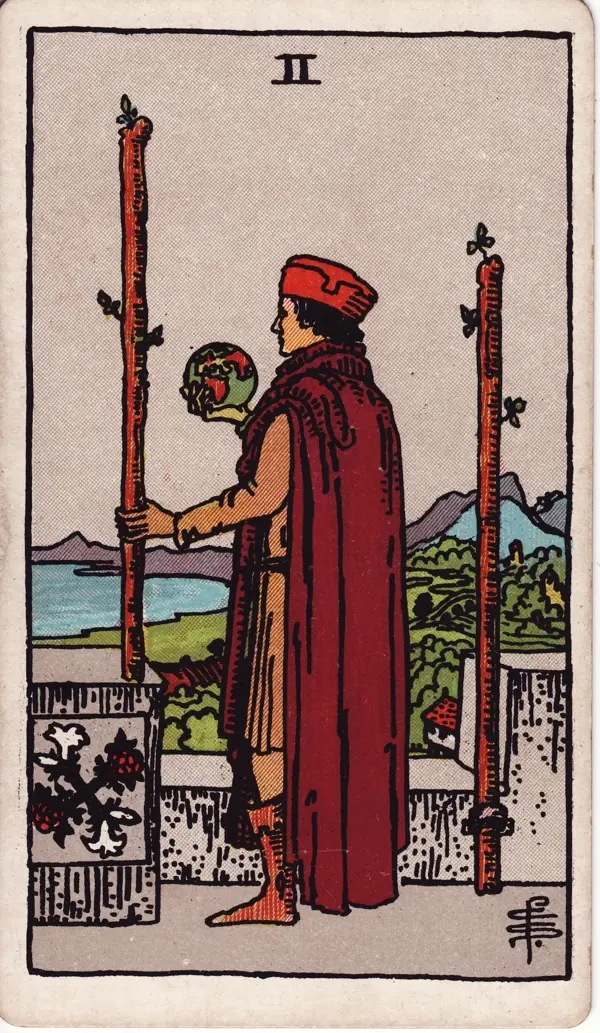
Compare the actual artwork, not only the card name
A different deck can alter the scene, color or relationships between figures. The same card name does not guarantee the same visual evidence. Look at the version being used before applying a description from Smith's deck.
Giving the artist credit also helps keep that distinction visible. The deck has an identifiable visual author and history. Its images are not interchangeable illustrations of fixed keywords.
Before opening the guide, name one gesture, one spatial relationship or one setting detail that stands out. Then read the source and compare it with that observation. An interpretation should be able to point back to something in the image or text.
Smith's work remains present in the details. Taking a moment to look at them gives the reading a firmer starting point and keeps the artist in view.
Sources
Pratt Institute, Pamela Colman Smith: Life and Work, for her training and wider work. Morgan Library & Museum, Pamela Colman Smith before Waite, for work preceding the commission. V&A, A history of tarot cards, for the deck's publication and later influence. Waite, Two of Wands, for the scene description. The observation exercise is original DuoSages work.
Two of Wands, illustrated by Pamela Colman Smith. Historical card scan. Image source and rights.