The Lovers can support a reflective discussion about a choice when the interpretation is tied to the image and question. It does not automatically mean romance, nor does its appearance decide which option is right. The values exercise below is a contemporary DuoSages application.

Begin with the pictured scene and its source
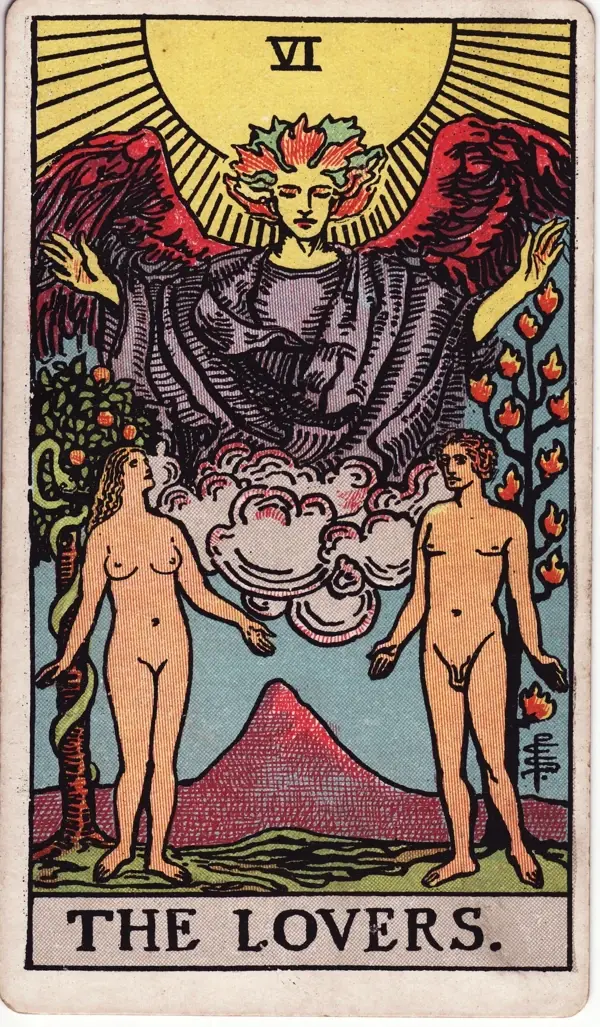
The Rider-Waite-Smith image shows two human figures beneath a winged figure, with a tree behind each person. Waite's Part II description draws on Biblical imagery and presents a spiritual account of love. That is the historical framework used here.
A present-day discussion can use the image to explore values and the conditions attached to a choice.
Give the choice real alternatives
In a hypothetical example, Leila has been offered two community commissions. One would pay promptly but leaves little room for her preferred method. The other allows more creative say, but its schedule and payment arrangements are less certain.
Her question is, ‘What needs to be clear before I choose a commission?’ Naming those conditions prevents the reading from turning into a vague argument between security and creativity.
Leila uses the Lovers image as a prompt to ask how agreement would work. What would she be consenting to in each arrangement? What would the commissioning group expect from her? Those questions are her proposed application.

Turn a value into a condition that can be checked
‘Creative freedom matters’ is a starting point. ‘Who approves changes to the design, and at which stage?’ is a question that can be answered. ‘Reliable payment matters’ becomes ‘What payment dates and milestones will appear in the agreement?’
The exercise asks Leila to express each priority as a condition. That makes comparison possible without treating one card as a substitute for examining the offers.
An appealing answer from a reading cannot resolve an unclear agreement. Leila can request written terms and compare them with the priorities she has named.
Notice what each choice asks in return
The first commission may require accepting a fixed design brief. The second may require allowing more time before the final work is approved. Neither requirement needs to become a moral judgment about the option.
Leila writes one sentence for each: ‘Choosing this would mean agreeing to ___.’ If the sentence cannot be completed with known terms, more information is needed. The reading has raised the subject of agreement; the terms supply its content.
The next step is to ask for the missing terms, then compare the actual offers. Leila can also decide that neither arrangement currently works. The card does not require choosing one merely because two options were presented.
A useful closing question is: ‘Which conditions must be true for this choice to fit?’ It can be revisited after information arrives, with or without another reading.
Sources
Waite, Part II, VI: The Lovers, for the image and historical framework. Leila, the commissions and the values-to-conditions exercise are original DuoSages work.
The Lovers, illustrated by Pamela Colman Smith. Historical card scan. Image source and rights.