For a reflective reading, the Death card can prompt questions about an ending and the arrangements needed around it. A card appearing in a session is not evidence that a literal death will occur. Read the actual image and the selected source before applying a theme to the situation.
This article uses the Rider-Waite-Smith image and a hypothetical studio closure. The contemporary application belongs to DuoSages.

Look beyond the title
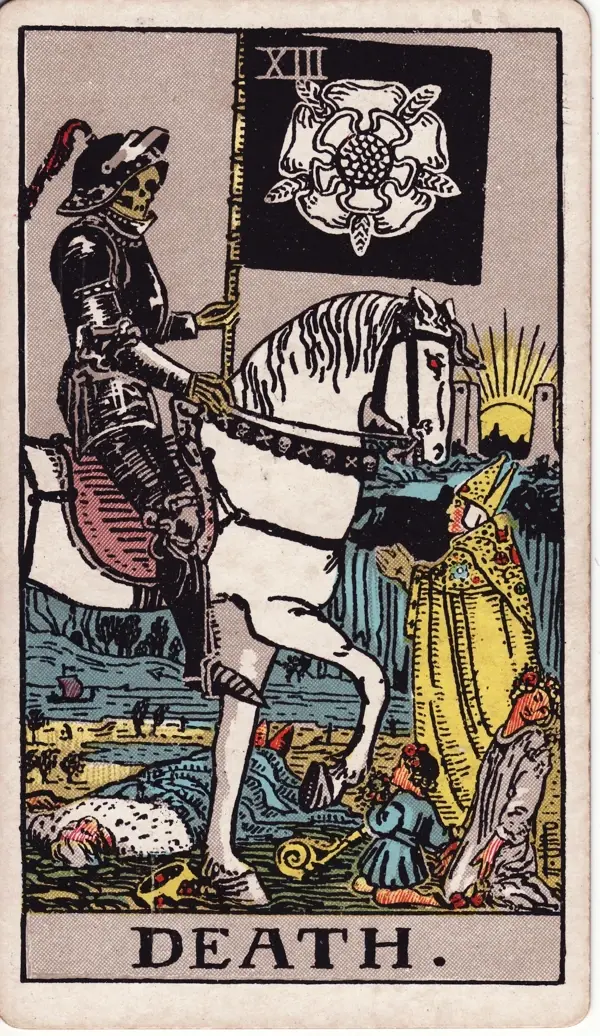
Smith's image includes a mounted skeletal figure, a black banner with a white rose and people responding in different ways. Waite's description also points to a sun at the horizon between two pillars. The scene gives more to examine than the single word printed on the card.
In Part II of his Pictorial Key, Waite discusses change and transformation while placing the image within an esoteric account of life and death. That framework should remain visible when his work is cited. A modern reflection on finishing a project is an application, rather than the complete meaning of his passage.
Name the ending precisely
A hypothetical pottery collective is closing its current studio because the building is being redeveloped. The question is, ‘What needs attention as this space closes?’ The lease ending is already known. The card has not revealed it.
The collective notices several different responses in the image and connects that observation with its own discussion. Some members want to move together; others plan to work elsewhere. That connection prompts a practical question: can the closure arrangements make room for different plans?

Separate what is finished from what must still be done
The lease cannot continue, but the collective still has choices about tools, unfinished pieces and the final workshop. A useful reading keeps those choices distinct from the ending itself.
The group decides to list shared equipment and agree on how it will be stored or transferred. It also asks members which unfinished pieces need collection. Those actions come from the actual studio situation, with the reading prompting attention to different responses.
The card does not require every member to welcome the closure or to describe it as an opportunity. An ending can include practical work without a cheerful explanation being imposed on everyone involved.
Keep a place for what continues
One member suggests documenting the kiln settings and glaze recipes before the room is cleared. Those records can continue to serve the group even if the studio arrangement ends.
That proposal is different from claiming that everything will be renewed. Some parts may continue, others may stop and some questions may remain unanswered. A careful interpretation permits all three possibilities.
A question to take away
Try: ‘What is ending, what still needs to be handled and what can continue in another form?’ Use the answers to make a short practical list. Do not require the card to settle the entire story.
If the image does not connect with the question, note that honestly. The name of a dramatic card is no reason to force a dramatic explanation.
Sources
Waite, The Pictorial Key to the Tarot, Part II, XIII: Death, for the image description and his esoteric interpretation. The studio closure and practical questions are original DuoSages applications.
Death, illustrated by Pamela Colman Smith. Historical card scan. Image source and rights.